
How to Get Rid of Lice: What Actually Works?
Getting rid of head lice means more than killing the insects you can see. To end an infestation, you need to address live lice, newly hatched lice and the eggs that remain attached to the hair.
If you have discovered head lice, your goal is not simply to kill a few insects. It is to interrupt the lice life cycle and prevent the infestation from continuing.
Families can choose from medicated shampoos, silicone-based lotions, prescription treatments and wet combing. These methods work differently, but they all face the same challenge: lice exist at several stages of their life cycle.
A treatment may kill crawling lice while leaving some eggs attached to the hair. This is why follow-up checks and careful mechanical removal remain so important.
What Should You Do When You Find Head Lice?
The first step is to confirm that there is an active infestation. The most reliable sign is finding a live crawling louse on the scalp or hair.
Nits can also indicate an infestation, particularly when they are firmly attached close to the scalp. However, empty or nonviable egg casings may remain visible after an infestation has ended.
Once head lice have been confirmed:
- Check the hair carefully under strong lighting.
- Choose an appropriate treatment method.
- Comb the hair systematically to remove lice and nits.
- Repeat checks according to the lice life cycle.
- Examine close household contacts for active lice.
Always follow the instructions provided with any topical or prescription treatment. Consult a healthcare professional when treating very young children, pregnant individuals or people with allergies or underlying medical conditions.
What Are the Main Ways to Get Rid of Lice?
Most head lice treatments fall into four broad categories.
1. Wet combing and mechanical removal
Wet combing uses a fine-toothed lice comb to remove crawling lice and eggs from damp or conditioned hair.
It does not depend on an insecticide and can be repeated throughout the lice life cycle. It may be used alone or as a complement to another treatment.
2. Silicone-based treatments
Some products use substances such as dimethicone to coat, immobilize or interfere physically with lice rather than acting through a conventional insecticide.
Their instructions and effectiveness vary by formulation. Combing can then help remove the lice and eggs that remain in the hair.
3. Over-the-counter pediculicides
Over-the-counter treatments may contain ingredients such as pyrethrins or permethrin. They are designed primarily to kill crawling lice.
However, some of these products do not reliably kill every unhatched egg. For this reason, a second application may be recommended after newly hatched lice emerge.
4. Prescription treatments
Prescription products may be recommended when an over-the-counter treatment has failed, resistance is suspected or another option is more appropriate.
Different active ingredients have different levels of activity against crawling lice and eggs. They must be used exactly as directed.
Why Killing Live Lice May Not Be Enough
The head louse life cycle includes three stages: egg, nymph and adult.
Attached firmly to a hair shaft.
A newly hatched immature louse.
A mature louse capable of laying eggs.
Female lice attach their eggs to individual hair shafts using a strong adhesive substance. These attached eggs are commonly called nits.
Scientific and clinical guidance recognizes that several commonly used topical treatments are not completely ovicidal. In other words, they do not consistently kill every egg.
An egg that survives the initial treatment may later hatch. If the newly emerged louse is not detected and removed, the infestation can continue.
Killing lice and removing an infestation are not exactly the same thing. A treatment may kill crawling insects while leaving dead lice, surviving eggs and empty egg casings attached to the hair.
Why a Lice Comb Remains a Key Treatment Tool
A lice comb performs a different function from a shampoo or lotion. Topical products are designed to kill, immobilize or interfere with lice. A comb is designed to physically remove material from the hair.
Thorough mechanical combing can remove:
- live adult lice;
- live nymphs;
- lice killed or immobilized by another treatment;
- viable eggs that remain attached to the hair;
- dead eggs and empty egg casings.
Public health guidance commonly recommends using a fine-toothed comb to remove dead or remaining live lice after treatment.
Combing also provides a direct way to monitor progress. By cleaning and checking the comb after each pass, you can see whether live lice are still present and whether the number being captured is decreasing.
Killing Lice and Removing Lice Are Different Jobs
Topical treatments
- Designed to kill or immobilize lice
- Some products do not kill every egg
- Dead lice may remain in the hair
- Does not detach empty egg casings
- May require repeat applications
- May be affected by resistance or incorrect use
Mechanical combing
- Physically removes lice from the hair
- Can remove eggs regardless of viability
- Removes both live and dead lice
- Can remove remaining egg casings
- Can be repeated without applying more product
- Does not rely on an insecticide mechanism
These methods do not necessarily need to be viewed as competitors. Depending on the treatment selected, combing can be used alone or as the mechanical step that removes what remains after a topical application.
How to Comb for Lice Correctly
A good lice comb matters, but technique also affects the result. Passing the comb quickly through large or tangled sections can leave lice and eggs behind.
Detangle first
Remove knots with an ordinary comb or brush before using the lice comb.
Work in small sections
Secure the rest of the hair and complete one section at a time.
Start at the scalp
Position the teeth as close to the roots as possible.
Comb slowly to the ends
Use a steady pass through the full length of the hair.
Clean after every pass
Wipe the comb on white tissue or paper towel and inspect what was removed.
Repeat each section
Continue until no additional lice or eggs are being captured.
Use strong lighting and pay particular attention to the areas behind the ears and around the nape of the neck.
Learn the complete combing technique
See how to prepare the hair, divide it into sections, clean the comb and schedule follow-up checks.
Read How to Comb for Lice Properly →How Often Should You Check and Comb the Hair?
A careful first session may remove a large proportion of the infestation, but follow-up is still important. Very small lice or surviving eggs can be missed.
When wet combing is used as the primary treatment, public health guidance commonly recommends repeating the process over several scheduled days. This helps capture newly hatched lice before they mature and lay more eggs.
When using a topical product, follow the exact timing stated in the instructions. Do not reapply medication more frequently than recommended.
Continue inspecting the hair between treatments and use the comb to remove remaining lice and nits.
Do You Need to Treat the Entire House?
Head lice depend on the human scalp to survive. They crawl; they do not fly or jump. Most transmission occurs through direct hair-to-hair contact.
Excessive cleaning, fumigation and insecticide sprays around the home are generally unnecessary.
Focus on checking people who have had close head-to-head contact with the affected person. Recently used items that have been in direct contact with the hair can be cleaned according to current public health guidance.
A Reusable, Lower-Waste Approach
Mechanical removal also offers a practical environmental advantage. A stainless steel lice comb does not require an active chemical ingredient and can be reused during treatment, follow-up checks and future infestations.
Unlike single-use bottles, disposable applicators or products that require repeated applications, a reusable comb generates very little treatment-related waste during normal use.
Nit Free Terminator is manufactured from stainless steel and designed for repeated use. Customers frequently report that combs purchased many years earlier remain in excellent working condition.
This durable construction allows one comb to support repeated inspection and removal sessions without requiring a new product for every infestation.
Mechanical removal can therefore provide a reusable, pesticide-free and lower-waste component within the overall treatment process.
Why the Quality of the Lice Comb Matters
Not every fine-toothed comb removes lice and eggs with the same efficiency. Tooth spacing, tooth length, rigidity and construction all affect how the comb moves through the hair and what it captures.
Comparative scientific studies of commercial lice combs have found meaningful differences between designs. In one published comparison, the ASSY metal comb—the design commercialized internationally as Nit Free Terminator—performed strongly in the removal of head lice and eggs.
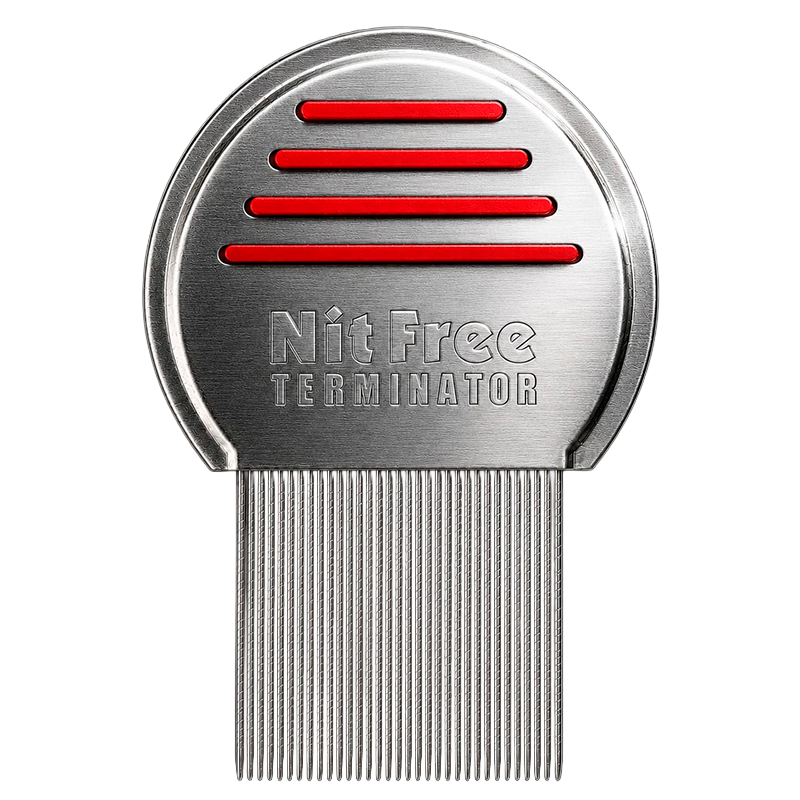
Nit Free Terminator was developed specifically for mechanical lice and nit removal. Its design includes:
- precision-spaced stainless steel teeth;
- micro-grooved tooth surfaces;
- long, rigid teeth for different hair types;
- a corrosion-resistant stainless steel structure;
- an anti-slip grip for greater control.
These characteristics help maintain close and consistent contact with the hair from the scalp to the ends.
Learn more in our guide to choosing the best lice comb.
Remove What Lice Treatments Leave Behind
Many products are designed to kill crawling lice. Nit Free Terminator is designed to physically remove lice and firmly attached nits from the hair.
Its precision-spaced, micro-grooved stainless steel teeth combine effective capture with the durability required for repeated combing and follow-up checks.
Frequently Asked Questions
Can you get rid of lice with combing alone?
Yes. Systematic wet combing can be used as a nonchemical treatment method. It must be performed carefully and repeated according to the lice life cycle.
Do lice treatments kill all the eggs?
Not always. Some commonly used treatments kill crawling lice but are not completely ovicidal. This is why repeat treatment and follow-up checks may be required.
Should you remove nits after treatment?
Nits may remain attached after treatment. Removing them clears the hair, makes future inspections easier and physically removes any eggs that may still be viable.
Can a lice comb remove live lice?
Yes. A properly designed fine-toothed comb can capture live adults, nymphs and eggs, as well as lice killed by another treatment.
Do you need to comb after using lice shampoo?
Combing after treatment helps remove dead lice, remaining live lice and eggs or egg casings that the product does not detach from the hair.
How long can a stainless steel lice comb last?
Useful life depends on construction, maintenance and frequency of use. Nit Free Terminator is designed for repeated use, and customers frequently report that combs purchased many years ago continue to work effectively.
The Most Important Step Is Complete Removal
There is no single treatment method that is ideal for every person or every infestation. Some families choose wet combing alone. Others combine mechanical removal with a topical or prescription treatment.
Whatever method is selected, the objective remains the same: remove crawling lice, interrupt their life cycle and prevent the infestation from continuing unnoticed.
Because many topical treatments are not completely ovicidal and do not detach nits from the hair, careful mechanical combing remains one of the most dependable components of head lice treatment.
Nit Free Terminator was designed specifically for that purpose. Its precision-spaced, micro-grooved stainless steel teeth physically capture lice and firmly attached eggs, while its durable construction supports repeated use during treatment, follow-up checks and future infestations.
Rather than simply targeting live lice, Nit Free Terminator helps physically remove the infestation from the hair—live lice, dead lice and nits—while giving families a direct way to inspect their progress.
This is why Nit Free Terminator is trusted by families, healthcare professionals and specialized lice clinics around the world, and why it sets the standard in mechanical lice and nit removal.
Scientific and Clinical References
- Centers for Disease Control and Prevention. Treatment of Head Lice. View source .
- Centers for Disease Control and Prevention. Clinical Care of Head Lice. View source .
- Centers for Disease Control and Prevention. About Head Lice. View source .
- National Health Service. Head Lice and Nits. View source .
- Lebwohl M, Clark L, Levitt J. Therapy for Head Lice Based on Life Cycle, Resistance, and Safety Considerations. Pediatrics. 2007;119(5):965–974. View source .
- Mumcuoglu KY, et al. International Recommendations for an Effective Control of Head Louse Infestations. International Journal of Dermatology. 2021;60(3):272–280. View source .
- Gallardo A, Mougabure-Cueto G, Vassena C, Picollo MI, Toloza AC. Comparative Efficacy of Commercial Combs in Removing Head Lice (Pediculus humanus capitis). Parasitology Research. 2013;112(3):1363–1366. View source .
- Speare R, Canyon DV, Cahill C, Thomas G. Comparative Efficacy of Two Nit Combs in Removing Head Lice Eggs. International Journal of Dermatology. 2007. View source .