
Best Lice Comb: How to Choose a Lice Comb Based on Scientific Evidence
Choosing the best lice comb involves much more than comparing brands or materials. Small differences in design, tooth spacing, rigidity and manufacturing precision can translate into meaningful differences in mechanical lice and nit removal.
Last reviewed: July 2026
Introduction
Choosing the best lice comb involves much more than comparing brands or materials.
Although most lice combs may look similar at first glance, small differences in design can translate into very different levels of performance during the mechanical removal of lice and nits.
Tooth spacing, tooth length, structural rigidity, manufacturing precision and the materials used all influence a comb's ability to detect and remove lice and nits consistently.
These differences are not only matters of engineering. Major international clinical guidelines recognize mechanical removal as an important component of head lice management, and scientific studies have demonstrated objective differences between commercial comb designs.
This guide brings together the available scientific evidence, recommendations from international health organizations and the main design criteria used to evaluate a high-precision lice comb.
Its purpose is to provide a technical, evidence-based framework for understanding what distinguishes a professional lice comb and how those characteristics may affect performance.
What You Will Learn
- What characteristics define a professional lice comb.
- What scientific evidence says about different comb designs.
- Why tooth spacing, structural rigidity and manufacturing quality influence performance.
- The differences between precision metal combs and other commercial designs.
- How to interpret clinical evidence and independent evaluations when choosing a lice comb.
About This Guide
This publication was developed through a review of the available scientific evidence on the mechanical removal of lice and nits and incorporates information from:
- International clinical guidelines, including recommendations from the Centers for Disease Control and Prevention (CDC) and the National Institute for Health and Care Excellence (NICE).
- Peer-reviewed scientific literature, with particular attention to comparative studies of lice combs.
- Independent editorial evaluations published by health and consumer publications.
- Engineering analysis, including variables such as tooth spacing, tooth length, structural rigidity, materials and manufacturing processes.
Editorial note: Some of the scientific publications cited in this guide evaluate a comb marketed under the ASSY® brand. The same engineering design is marketed internationally under the Nit Free Terminator® brand. Although the brands are owned by different rights holders and used in different markets, the product maintains the same functional geometry, materials and manufacturing process.
What Does Clinical Evidence Say About Mechanical Removal?
Mechanical removal is one of the most widely accepted strategies for managing head lice.
The Centers for Disease Control and Prevention (CDC) recommends the use of a fine-toothed comb to detect and remove lice and nits during treatment and follow-up.
Similarly, the National Institute for Health and Care Excellence (NICE) recognizes wet combing as a valid approach when performed with the appropriate technique and frequency.
These recommendations do not endorse any specific commercial product. Rather, they support the use of an appropriate comb as part of the overall management of a head lice infestation.
If there is such broad agreement on the method, one question naturally follows: do all lice combs perform equally well?
The available evidence suggests they do not.
For a broader look at mechanical removal within head lice treatment, see our guide on how to get rid of lice.
Do All Lice Combs Work the Same Way?
Although many lice combs look similar, there are objective differences in their design and manufacturing that can influence performance during mechanical removal.
These differences have been recognized from several perspectives. International clinical guidelines emphasize the importance of using an appropriate comb as part of treatment.
Engineering principles indicate that variables such as tooth spacing, tooth length, structural rigidity and manufacturing precision can affect the way a comb behaves during use.
In addition, some comparative studies have directly evaluated different commercial designs.
One such study, published in Parasitology Research in 2013, compared the effectiveness of several commercial combs under controlled experimental conditions.
The researchers observed significant differences between the models tested and concluded that the design marketed under the ASSY® brand showed the best performance for the removal of lice and eggs.
As explained in the editorial note above, that same engineering design is marketed internationally as Nit Free Terminator®.
The performance of a lice comb does not depend on a single feature, but on the interaction of multiple design variables and the manufacturer's ability to reproduce them accurately.
What Characteristics Make a Lice Comb Truly Effective?
The effectiveness of a lice comb does not depend on a single attribute.
It results from the interaction of several design variables that determine how the comb moves through the hair and captures lice and nits during each pass.
Among the most important factors are tooth spacing, structural rigidity, tooth length, surface geometry and handle ergonomics.
Tooth Spacing
Tooth spacing is one of the most important factors in the performance of a lice comb.
If the gap is too wide, some lice or nits may pass between the teeth.
If it is too narrow, the comb may lose fluidity on certain hair types if the rest of the design does not support that geometry.
For this reason, tooth spacing should always be evaluated together with the other design variables rather than in isolation.
Structural Rigidity
The precision of a lice comb depends not only on the distance between its teeth, but also on its ability to maintain that geometry during use.
When combing thick, long or dense hair, the structure of the comb is subjected to forces that may alter tooth alignment.
Greater rigidity helps preserve that geometry and supports more consistent performance over time.
For this reason, many professional lice combs use stainless steel as a structural material.
However, the material alone does not guarantee superior performance. The overall quality of the design remains the decisive factor.
Tooth Length
Tooth length determines the comb's ability to pass through different volumes of hair.
Teeth that are too short reduce the effective working surface and may make combing more difficult in long or dense hair.
Micro-Grooved Teeth
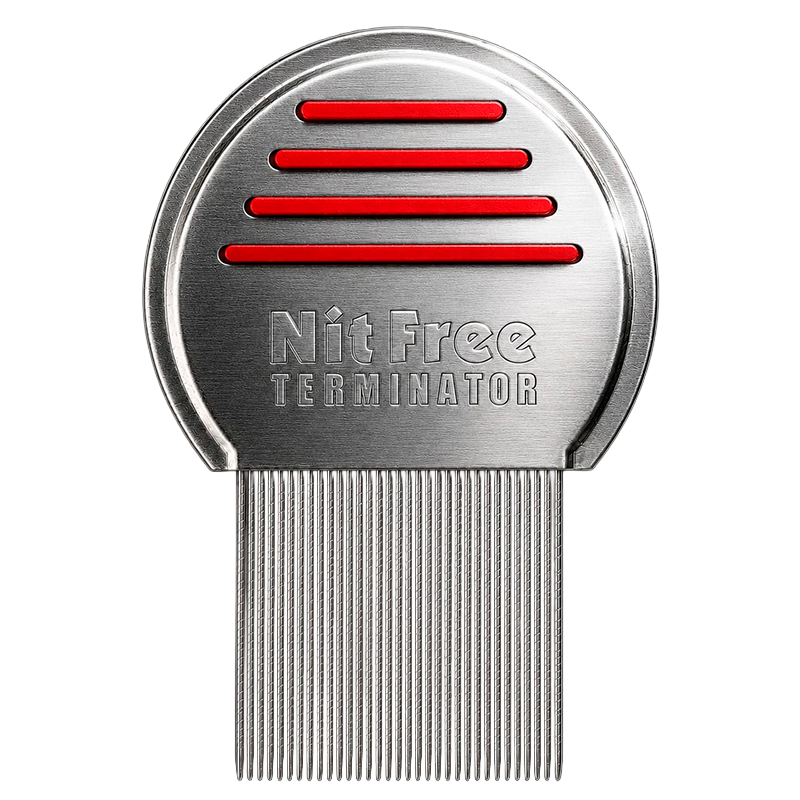
Nit Free Terminator® teeth feature micro-grooves machined along the active surface.
Unlike a completely smooth tooth, these microscopic grooves create multiple points of contact with the nit during combing.
As the comb passes through the hair, the micro-grooved surface helps increase grip on the nit, supporting its removal from the natural adhesive that keeps it attached to the hair shaft.
At the same time, distributing contact across numerous very small grooves reduces slipping over the nit without requiring increased pulling force on the hair.
The purpose of this design is to maximize control during the mechanical removal of nits while maintaining precise and comfortable combing.
Learn more about how micro-grooved teeth work.
Ergonomics
Precision also depends on the amount of control the user can maintain during combing.
An ergonomic handle helps the user perform continuous passes from the roots to the ends and reduces fatigue during longer sessions, especially on long or dense hair.
Nit Free Terminator incorporates four anti-slip grip bands designed to improve handling and provide greater control during use.
Performance Is the Result of Design
No single feature determines the effectiveness of a lice comb.
Performance comes from the combination of geometry, materials, structural stability and ergonomics.
Looking at each of these factors helps explain why two combs that appear almost identical may produce different results.
It also leads to another fundamental consideration: the manufacturer's ability to reproduce that design with the same level of precision in every unit.
Manufacturing Quality: When Design Must Be Reproduced Precisely
A good design is the starting point for a high-performance lice comb.
However, that design only retains its value if it can be reproduced consistently throughout the manufacturing process.
Tooth spacing, alignment, length, surface finish and the connection between the comb and the handle all depend on tolerances that must remain within defined parameters.
Small variations, often invisible to the user, may alter the behavior of the comb during mechanical removal.
The quality of a lice comb therefore depends both on its design and on the manufacturer's ability to reproduce that design with the same specifications in every unit.
What Should a Manufacturer Control?
Specific procedures vary between manufacturers, but a quality-control system for a precision lice comb should include, at a minimum:
- Tooth alignment.
- Uniformity of tooth spacing.
- Structural integrity of the comb.
- Tooth-tip finish and rounding.
- Correct attachment between the metal structure and the handle.
- Absence of deformation or visible defects.
- Visual inspection before product release.
These controls are intended to ensure that every comb retains the characteristics for which it was designed.
Why Is Stainless Steel Commonly Used in Professional Lice Combs?
Combs designed for intensive use are often manufactured from stainless steel because of its mechanical properties and durability.
Its main advantages include:
- Greater structural stability during combing.
- Resistance to corrosion.
- Tolerance to repeated cleaning and disinfection.
- Long service life.
However, material is only one component of the design.
A stainless steel comb will not necessarily perform better if its geometry, manufacturing process or quality controls do not meet the required standards.
From Engineering to Evidence
So far, we have reviewed the design and manufacturing principles that influence the performance of a lice comb.
The next question is equally important:
What independent evidence exists to evaluate how those principles translate into real-world performance?
To answer that, it is useful to consider three complementary types of evidence:
- Peer-reviewed scientific research.
- Independent editorial evaluations.
- The accumulated experience of thousands of users.
Each provides a different perspective, and together they offer a more complete view of lice comb performance.
What Independent Evidence Exists for High-Precision Lice Combs?
Up to this point, we have examined the engineering principles involved in lice comb design: tooth spacing, structural rigidity, tooth length, materials and manufacturing quality.
The next question is inevitable:
Is there independent evidence showing how these characteristics translate into product performance?
The answer is yes, although not all evidence has the same scope.
To interpret the available information correctly, it is useful to distinguish between three complementary sources:
- Scientific research, which compares the performance of different designs under controlled conditions.
- Independent editorial evaluations, which assess product quality and user experience.
- Accumulated user experience, which reflects how a product performs in real-world conditions.
Each source answers a different question.
Taken together, they provide a much stronger framework for evaluating a lice comb than any one source on its own.
Scientific Evidence
Scientific research provides the strongest level of evidence for comparing the performance of different lice comb designs.
A study published in Parasitology Research compared the effectiveness of several commercial metal and plastic combs for removing lice and eggs under controlled experimental conditions.
The researchers found significant differences between the models evaluated.
In those comparisons, the comb marketed under the ASSY® brand showed the best overall performance for the removal of lice and eggs.
As explained earlier in this guide, that same engineering design is marketed internationally under the Nit Free Terminator® brand.
Beyond the specific result, the study supports an especially relevant conclusion:
Relatively small differences in tooth spacing, length and geometry can translate into objective differences in mechanical removal performance.
Reference: Parasitology Research. 2013 .
Independent Editorial Evaluations
Scientific evidence helps explain how a product performs under controlled conditions.
Independent editorial evaluations offer a different perspective by looking at construction quality, user experience and observed performance from the standpoint of health and consumer specialists.
In recent years, Nit Free Terminator® has been recommended by several specialized publications.
Health.com highlighted its stainless steel construction, micro-grooved teeth and durability as distinguishing features within the lice comb category.
Verywell Health included it among its recommended combs for lice and nit removal, noting the precision of its stainless steel teeth and its ability to support the removal of nits attached to the hair.
In 2025, NBC Select named Nit Free Terminator the "Best Nit Comb", highlighting its stainless steel construction, precise teeth, rounded tips and anti-slip handle.
The publication also noted that the product had accumulated more than 19,000 verified Amazon reviews.
These publications are not clinical studies and should not be interpreted as scientific evidence. Their value lies in the fact that they were produced by independent editorial teams using their own evaluation criteria and are not affiliated with the product manufacturer.
The Experience of Thousands of Users
A third source of information comes from the accumulated experience of people using the product in real-world conditions.
At the time this guide was prepared, Nit Free Terminator had more than 17,000 verified Amazon reviews, making it one of the most extensively reviewed lice combs in its category.
User reviews do not replace scientific evidence and cannot be used to draw clinical conclusions.
However, they provide useful information about aspects such as:
- Durability.
- Ease of use.
- Perceived quality.
- Overall satisfaction.
These are variables that are often difficult to measure in a clinical trial.
When the same product maintains thousands of positive reviews over many years and across different markets, that accumulated experience provides a useful complement to scientific and editorial evidence.
Professional Use in Specialized Lice Clinics
There is a fourth source of information that, while not scientific evidence, provides an especially valuable perspective: the experience of clinics dedicated to professional lice removal.
These centers perform treatments on a daily basis and use their tools intensively, so the selection of a comb often reflects practical considerations such as performance, durability and consistency.
Nit Free Terminator is used by specialized lice clinics and professionals around the world.
This professional adoption does not constitute clinical evidence of product efficacy, but it provides a relevant perspective on the use of the product in real-world professional settings.
Although adoption by specialized clinics does not replace scientific evidence, it offers a practical reference because it comes from professionals who use these tools frequently and intensively in routine practice.
An Integrated View of the Evidence
Scientific evidence shows how different designs behave under controlled conditions.
Independent editorial evaluations assess product quality from the perspective of health and consumer specialists.
The experience of thousands of users provides information about product performance in real-world use.
Adoption by specialized clinics adds another perspective on professional use, where these tools are used frequently and intensively.
Although this adoption does not constitute scientific evidence, it provides a relevant reference regarding the use of the product in professional practice.
Each of these sources has its own strengths and limitations.
However, when they converge around the same product, they provide a broader level of support than any one source considered in isolation.
In the case of Nit Free Terminator®, that convergence is particularly relevant: the same design has been evaluated in the scientific literature, recommended by independent specialized publications, used by specialized lice clinics and validated by thousands of users over many years.
How Should You Evaluate a Lice Comb?
| Criterion | What to Look For |
|---|---|
| Material | Corrosion-resistant stainless steel |
| Tooth spacing | Uniform and consistent |
| Rigidity | A structure that maintains its geometry during use |
| Tooth length | Sufficient to pass through different volumes of hair |
| Ergonomics | A handle that supports control during combing |
| Manufacturing quality | Processes that ensure consistency from unit to unit |
Conclusion
At first glance, many lice combs look almost identical.
However, the available evidence shows that small differences in design and manufacturing can translate into objective differences in performance during the mechanical removal of lice and nits.
Throughout this guide, we have reviewed major international clinical recommendations, the available scientific literature and the engineering criteria involved in the design of a precision lice comb.
Taken together, this information supports a clear conclusion:
The effectiveness of a lice comb does not depend on a single feature, but on the balance between its geometry, structural stability, material quality and the consistency of the manufacturing process.
Regardless of brand, these are the criteria that should guide the selection of any lice comb.
Designed Around the Principles That Matter
Nit Free Terminator brings together the key characteristics that define a high-performance lice comb: precision-spaced stainless steel teeth, structural rigidity, micro-grooved surfaces and a design built for consistent mechanical removal.
References
- Centers for Disease Control and Prevention (CDC). Clinical Care of Head Lice. View source
- Parasitology Research. 2013. View study
- Health. Best Lice Treatments. View article
- Verywell Health. Best Lice Treatments. View article
- NBC Select. Best Lice Treatments. View article
- Amazon. Nit Free Terminator – Customer Reviews. Accessed July 2026. View reviews